Tephra is fragmental material produced by a volcanic eruption regardless of composition, fragment size, or emplacement mechanism.
The Volcanic Explosivity Index (VEI) is a scale that describes the size of explosive volcanic eruptions based on magnitude and intensity. The numerical scale (from 0 to 8) is a logarithmic
scale, and is generally analogous to the Richter and other magnitude scales for the size of earthquakes.
However, when the most
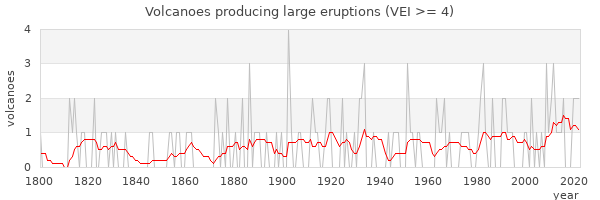
recent data (1991 - 2021) is included, increase in stronger volcanism is evident too, as shown in Fig. \fig4.
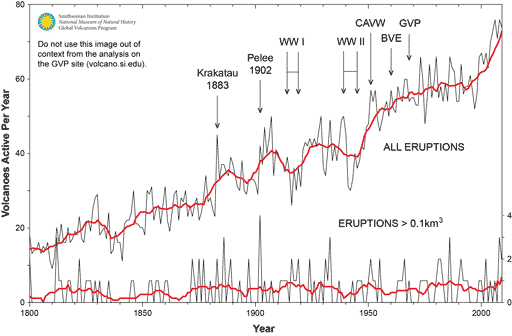
This suggests a great stock market collapse and another great depression in or about the year 2023.
If volcanism is, in long-term, increasing (as hypothesized), wars and depressions might attenuate the rise, but the longer these last, the higher may be the increase in volcanism afterwards.
2024.03.12 Apparently, the years 2022 and 2023 were extremely quiet regarding strong volcanic activity. In 2022, only one event of VEI = 3 was reported (none of VEI 4 or higher). In year 2023, there were no events of magnitude ≥ 3 (unless, again, there is a significant lag in reporting). Since, at the same time, there was an increase in wars, this goes in favour of the above hypothesis of deeper correlation between the two. This low volcanic activity is now a stronger signal for the imminent stock market collapse and depression.
2024.04.08 Note that, apart from land volcanism (which may not be as strong), I have specifically predicted a larger increase in sea-floor volcanism, which should increase both ocean acidity and ocean temperature. Although it may take some time for the evident increase in acidification near surface, this may not be so for temperature. Note also that the figures above mainly reflect the volcanism on land, as most of the ocean floor (and, thus, the sea-floor volcanism) is uncharted. Now, land and sea surface temperatures have rapidly increased last year, while sea ice extent in Antarctica was the lowest on record by a wide margin. The anomalies are described as being "off the charts". This global rapid increase in temperature in 2023 cannot be explained by greenhouse gas emissions. It cannot be explained by the phase-out of sulphur in marine fuels in 2020, because any large impact on climate would show up in 2021/2022 already, not suddenly in 2023. Similar is the case with Hunga Tonga eruption, any effect of which on climate should be relatively modest, the net effect is probably even negligible considering the amounts and distribution of the components that cool the planet (sulphur) and those that warm the planet (water vapour). Solar cycles are not the culprit either. Not only are all these impacts on climate small, the expected changes in impact from 2022 to 2023 are miniscule. Even El Niño, which should impact 2024 temperatures, due to lingering global temperature impact of La Niña in the first part of the year, was not expected to have a net effect on temperatures in 2023. And if it wasn't El Niño, what was it? The only remaining explanation is the increased sea-floor geothermal activity (volcanism). If that is the case, this is obviously not a continuous process, rather occurring in bursts, possibly of similar magnitude. Note that equally rapid increase in temperature (0.29 °C) was detected in 1977. In 1976, temperature [relative to pre-industrial levels] was 0.15 °C, in 1977 it was 0.44 °C. In 2022, the temperature was 1.15 °C, in 2023 it was 1.44 °C. The same amount of rise, 1 °C difference between the events, could we then expect the same jump at 2.15 °C, sometime in the period 2040-2045 (assuming climate stays on the current trajectory)? Do we have a satisfying explanation for the rapid rise in 1977? Again, the solar cycles and greenhouse gas emissions cannot explain it. The situation is even worse with sulphur and volcanism. In 1976/1977 global sulphur emissions were still rising (producing a cooling effect). Some relatively strong volcanism was present in years 1973-1976, there were 4 volcanoes with eruptions having a VEI of 4 (Chachadake [Tiatia], Fuego, Tolbachik, Augustine), but this is 10 times weaker than the Hunga Tonga (VEI 5) eruption, and none of these eruptions included significant water vapour. Note that the El Niño Southern Oscillation (ENSO) and the global climate entered a new regime in 1977, correlated also with Pacific Decadal Oscillation. This suggests we probably have entered a new climate regime in 2023 as well. One could now argue that a rapid change in ENSO is the reason of rapid temperature rise but what caused the shift in ENSO? ENSO links atmosphere with sea surface temperatures, but it is also linked with oceanic overturning circulation and the deep ocean. With no rapid changes in the atmosphere, perhaps the trigger is in the deep ocean. Considering that regime changes seem to come after strong volcanic activity on land (this was the case in 1977 and it was the case in 2023) perhaps this stronger volcanic activity is not limited to land, it occurs relatively simultaneously in deep ocean, perhaps even in greater magnitude. In that case, this is not regular shallow tectonic activity, rather correlated with mantle plumes (characteristic for major extinctions). 2024.08.15 A recent study shows that Hunga Tonga net effect was indeed very small. Also, the net radiative forcing was negative - producing cooling, rather than warming.
2025.09.10 Reports on volcanism have been updated. Changes have occurred for the last ~10 years. Fig. \fig5 shows the latest data.

UPDATE 2022.08.22
Recent research confirms that climate change will, mainly due to increase in rainfall (correlated with increase in temperature), lead to more eruptions.
Increasing greenhouse gases should thus be followed with increasingly massive eruptions and possibly a decline in mid-size and smaller eruptions - if the attempts of temperature regulation are to
continue.
Recent research confirms that climate change will, mainly due to increase in rainfall (correlated with increase in temperature), lead to more eruptions.
The volcanic ejecta needs to reach the stratosphere for a significant cooling effect. As the troposphere warms it expands in height, making it harder for particles ejected in smaller eruptions
to reach the stratosphere.
Therefore, generally, smaller eruptions might be decreasing with the appearance of ultra-massive eruptions (due to long-term warming effect).
However, in case of major extinctions (when at least some life should be, per the hypothesis, migrating
towards the mantle within a relatively short time-frame) this decrease is probably unlikely.
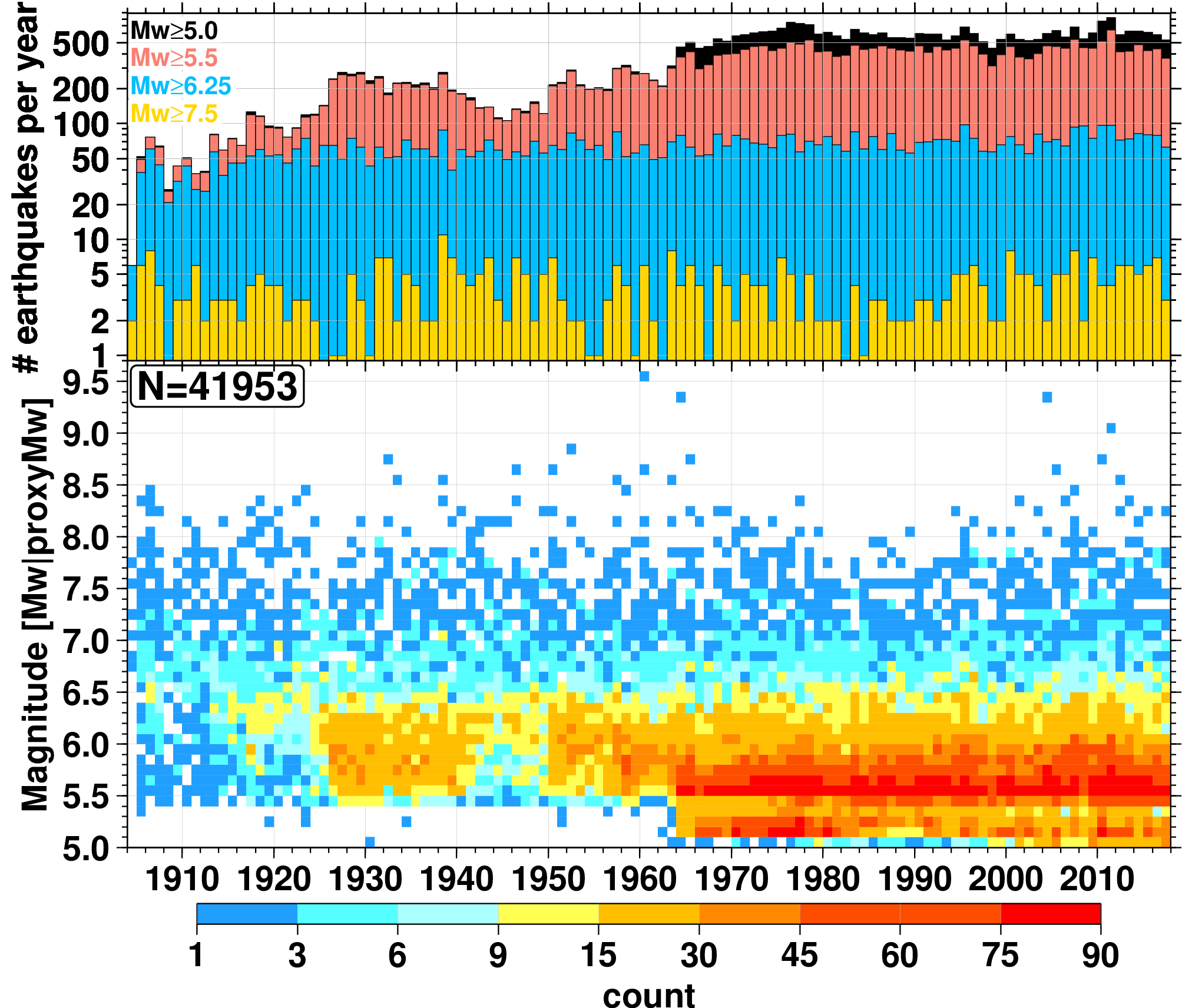
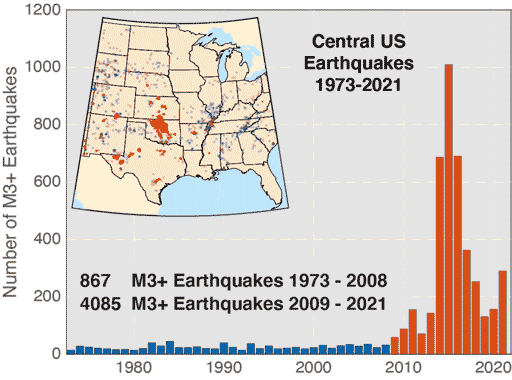
If volcanism is highly correlated with human activity, how about earthquakes? Should we interpret the human production of earthquakes as non-natural, or simply as another part of the forces acting
on the planet? If we would stop causing earthquakes, would the earthquakes of that magnitude continue anyway, by some other mechanism? I wouldn't be surprised.