Intro
Houses in cancerous society are generally too wasteful and built on anthropocentric principles, replacing wildlife and healthy environments with artificial, domesticated life and sterile
environments. While isolation from wildlife is not bad per se, it is unsustainable when it is not balanced. In short, isolation should include in situ production of resources if
resources taken from wildlife are not balanced with resources given back, or shared, to ensure its survival.
The isolated system should be a self-regulated eco-system on its own - a closed (self-sustainable) system with its own atmosphere and [re]cycling of energy, a system that does not grow
uncontrollably (have an infinite growth policy). Absolute isolation is, however, impossible (but, as stated, also unnecessary with symmetric energy exchange), but modern habitats, especially those
in cities, are far from being even remotely self-sustainable. Yet, the habitats and their consumption of remote resources are still growing.
This is one proposal of the alternative.
A living house, precursor
Even while I was expressing polarized behaviour I always liked wooden houses. I thought concrete houses are ugly, screaming with artificial crafting, colours, carefully guarded but wasted and dead
spaces in between calm natural greenery.
Now that I am conscious of my nature, I know why I felt that way. Houses built out of wood, soil and natural rock are generally non-cancerous (environmentally friendly) and can be truly sustainable
and non-expensive, compared to expensive and sustainable or green houses made out of artificial materials.
Of course, depending on desires, a wooden house can be more expensive than a concrete one, but that is generally due to greed and inverted values in society - sure, it is cheaper to buy an
industrial tomato than a home-grown one, but is it better and is it really cheaper in the long term? To eat subsidized chemically treated taste-lacking substance grown as mono-culture on killed
wildlife? That's not cheaper, that's suicidal (it is only virtually cheaper, because it is subsidized). The same goes for housing.
In any case, if one is interested in sustainable living, one is interested in symbiosis with environment and as much local production and waste consumption as possible.
Construction
It would be good not to think of a house as a construction that has a single purpose - to serve humans (modern constructions are generally contraptions, a master of a house is also its slave), at
any cost to the environment. An ideal house would be something that grows and adapts to one as much as one grows and adapts to it. A house that breathes and regulates its internal atmosphere.
Such are organic houses. While a truly living house might still be in the future, organic precursors can be built already.
A house of wood
If one is going to make a house of wood, it would be good to make it out of older trees. Old trees
radiate more CO2 than they absorb, so by cutting them down, even though one is killing them, one is not necessarily doing much damage to the ecosystem (this is why wild-fires in
thick old forests are good - they enable new young and CO2 absorbing trees to grow). Of course, sometimes this might require planting some trees also, in order to keep the system in
balance (or restore balance, as often is the case in current climate).
If one does not like killing trees, even old ones, one can try finding dead and wounded ones, these should be easier to take, however, trees are strongly introverted organisms and it is highly
unlikely they feel physical deformation as strong pain.
The trees can be injured and they do react to injuries but, if they are strongly introverted, they probably don't consciously strongly feel external force simply because it wouldn't help them
much since they don't have moveable limbs nor the ability to move. On top of that, they are very resilient. With extroverted consciousness being minimal they probably spend most of their life
dreaming (they do have usable brain equivalents in the roots and mycorrhizal networks), similar to whales (who, on the other hand, do feel pain because they're more extroverted and more
vulnerable). Generally, the more introverted the organism is the less externally induced pain it should consciously feel (one extreme of this introversion is the planet Earth). It will react to
action but non-consciously - similar to any immune system reaction.
Even so, one might opt out to collect already dead trees, but then one will probably want to mix these with something else (soil) to build a house. It is good to search for dead trees after
a storm, as there will usually be good wood lying around.
Dead trees are needed in a forest as well, so even these should be taken responsibly.
Note that
trees have memories, feelings, form friendships and families - relatively, they are
animals. Their brain equivalent is, however, underground and, even if cut above ground, the tree (stump) may survive (even if it won't regrow) as long as others find it valuable and as long as
it's possible for nearby trees and fungi to provide nutrients.
Compressed straw (straw bale), for example, provides excellent heat insulation, typically, equivalent to 25 cm of stone wool (mineral wool), for 1/10 of the price, or less.
Location
I find the best location for a house on a hill, or a mountain. It is more windy and air is of better quality. Wooden walls also help here, keeping indoor air at good quality, eliminating the need
for constant air conditioning. But this location is good for other reasons too - wastewater disposal, good drainage (flood resistance), etc.
Ideally, a water source should also be nearby, but this is not necessary if rain can be collected and filtered.
Wastewater disposal
Suppose the house is on a hill, up north.
If the forest is just south of the house (if not, one should plan to grow a small forest south or south-west, south-east of the house), it would be good for waste disposal channels to lead
to this patch of land - this is where faeces, urine and other waste water should go (anything not rich in chemicals that badly affect wild-life).
In order to prevent piling up of waste, the leading channel should be split into multiple smaller channels leading to different parts of the land (1 channel per inhabitant should be enough, at least
in case of healthy inhabitants).
The channels may start underground from the house, but the waste should exit on land surface.
It generally takes 1 (one!) day for faeces to be absorbed by the soil on a healthy forest floor.
Of course, there's no need to use indoor facilities - it might just be an unnecessary complication.
Garbage
If one lives sustainably, there will be no long-term garbage in waste. Everything should be bio-degradable within a reasonable time-frame.
Unless one already has some, plastic probably should not be used nowadays, it
will never be recycled in significant quantity by humans.
It is not excluded that nature will, with accelerated evolution, select and spread microbes that can efficiently degrade it, however, those who live sustainably are not gamblers enough to count
on that. Also, isn't plastic ugly?
However, plastic can be very usable (e.g., for water pipes) and it is not inherently bad (it's currently bad due to overpopulation and irresponsibility of an average human).
Energy
Anything that has a big impact on environment should not be an option. A working wind turbine is affecting big birds, insects and [important!] wind circulation patterns. Environmental cost of
production and maintenance should also be taken into account.
Anything affecting birds and insects is further affecting those who depend on them and due to universal entanglement of life, this can have far-reaching consequences. Generally, the larger
wind turbine is the more cost-effective it is, but again, the cost here is cost in absolute money, not long-term [or any] cost of impact on environment (life).
If one wants a wind turbine, it would be good to make sure it is cost-effective not cost-effective.
Similar can be applied to solar panels - they might not have large impact on larger wildlife, but they replace (shade) wildlife and also impact the climate.
Solar panels on a roof might not cover a large area just like a car might not use a lot of fuel, but things add up on global scale and, with everything taken into account, can end up being
unsustainable. However, like stated earlier, if the impact is small (one or a couple of panels per person) and it is balanced, it should not be a problem.
The key is to be conscious of the magnitude of impact and is it cost-effective (sustainable in the long-term).
Solar panels as part of roof structure might sound good, but solar panels are also expensive and inefficient - it is better to cover the roof with soil and let plants grow there, providing one
with cheap temperature regulation in return (one can put some panels but it would not be good to cover the whole roof with them, especially if there are no plants below them).
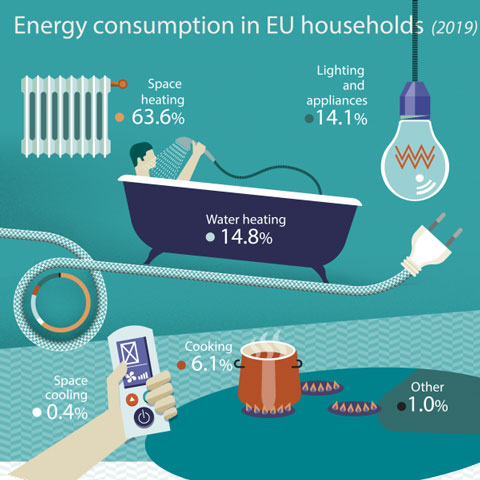
Consider Fig. \fig1.
Fig. \fig1: Energy consumption in EU households
In a typical EU household, 64% of energy is used for heating air and 14% for heating water - that's almost 80% of energy used for heating.
Interestingly, human body also converts 80% of consumed energy into heat - so most our houses are as inefficient as we are.
However, energy efficiency is not a requirement for sustainability. Nature often wastes energy somewhere only for that energy to be used somewhere else.
Bear, for example, won't normally eat the whole salmon, but someone else will finish the remains.
And that is the key to sustainability - recycling and sharing energy, not energy efficiency (especially not in polarized humanity, as Jevons paradox clearly shows).
In fact, energy efficiency can be linked to loss of diversity - if our bodies would be more energy efficient, who would heat [and thus sustain] the ecosystems living in and on us (that we cannot
live without)?
Bear, for example, will eat the whole salmon when there's not much salmon. That's less food for others, decreasing diversity. But why is there less salmon, if not due to loss of diversity in the
first place?
Waste is thus not a problem, it's a necessity, but it has to be recycled - not trashed on piles.
The problem with modern houses is not that they are inefficient, the problem is - they're selfish. They are not designed to share energy with the ecosystem they're part of. First, a lot of
material (energy) is taken from the environment for the construction of the house and then energy is continuously being taken from the environment to sustain people inside that house.
The main output of such house that goes to environment are greenhouse gases and plastic, often harming the environment. And the thing that would be beneficial to environment (human excreta) is
collected on piles, unsuitable for use by nature and often out of reach for nature (in polarized people, it may also often contain diseases, antibiotics and other shit).
If one is not prepared to give much, one should not take much.
To be sustainable, negative impact on the environment should be matched by positive impact. In example, if one outputs excess CO2 to environment, one should fertilize the land and let
enough plants grow to soak it all up (be a part of Earth's self-regulating mechanism).
Commonly, a lot of energy is spent to fight nature, keep households isolated and sterile, and to safeguard resources (energy) taken from nature. This makes one weak, unhealthy for itself and for the
environment, requiring even more energy to stay alive. As such, one is not part of Earth's self-regulating mechanism, it is a disruptor of normal function - a disease.
However, the bigger the impact the harder it becomes to keep the ecosystem in balance. To ensure long-term sustainability, the best practice would then be to reduce the impact.
One should not haul materials from one part of the country to the other in order to build a house and one shouldn't overly use synthetic insulation that traps energy, rather natural insulation that
regulates temperature.
If one has ever lived in [one mouth] caves one would have noticed that temperature there is roughly constant throughout the year and roughly equal to yearly average temperature on the surface.
The global average surface temperature is currently about 15° C, and rising.
Thus, optimal solution is a house that's underground (or at least partly) with a top covered with soil and plants. In such house one can survive a whole year without heating, but if one does heat
it one won't need much energy to achieve optimal temperature.
However, if that energy cannot be extracted sustainably, it would be better to wear a jacket inside the house.
Heating energy source
Even if a house is done right - in a way no energy is required to heat the air [and thus humans] inside, one will probably have needs for hot water.
In that case, locally available energy source should be used for heating. That can be wood, but it should be harvested properly.
Sustainable harvesting includes thinning of dense stands and removal of poorer quality trees, while leaving seed trees of all present species and ages, and some standing dead trees - to provide
wildlife habitat.
Healthy forest can give 4.5 m3 of wood per
hectare (10000 m2) per year, forever. Some claim it can give 10 m3 per hectare per year but the same ones often use a lot of wood for heating (they're biased).
The number should depend on the forest, but, in any case, one should not aim to use more than 5 m3 of wood per year per person.
Land on Earth used by people should not be more than 1.5 hectares per person (for a population of 7.7 × 10⁹) and at least 1 hectare of that should be a forest with wild animals.
Electricity
Sometimes, there are better alternatives than using electricity to get energy or work done. One should not be afraid to use body parts to do some occasional work if one does not want to lose
them completely.
Large and noisy machines affect diversity of life and should not be used - if one is in a hurry, making jobs out of work, one is likely cancerous. One should not have to work a lot, one should
do satisfying work, not have, or strive to have a lot of space and material possessions for which one does not have time to care for.
If one is not cancerous, electricity demands will generally be low and could probably be satisfied with one small-scale low-impact electricity source or a combination of such sources.
To me, an ideal electricity source would be a small wooden turbine on spring water, with no forced accumulation of water. But, in any case, one should use a source that's locally available.
While, a fusion reactor might be the ideal source of electricity, for now, too much brute force is still required to get something usable. While I am sure that
applying complete
relativity to fusion reactor designs can improve the yield, I am not sure any more if that
energy source can be cost-effective for us or our scale of life. Sustainable energy source should not require so much brute force - if it does, then it certainly was not meant for us, but
for larger scale life-forms, such as the Sun. Sustainable energy sources are generally provided by the god organism (Earth, in our case).
However, it cannot be ruled out that a way to create and sustain fusion reactions more easily won't be found. I am still doing experiments with low-energy reactions.
In any case, high energy, thermonuclear fusion reactions are not meant for us and it is highly unlikely these will ever be cost-effective for humans.
Chapter Food revised.
Food
In extremely cancerous society nothing is produced in situ. Everything is separated into specialized departments and there is no holistic approach to problem solving.
However, without such approach problems are rarely solved, more commonly, new problems are introduced - they are just not labelled as problems, rather as new jobs.
In such society no one is concerned about food when building a house. The values are so inverted that people care least for things they need the most.
If one does not want to be cancerous one will have to think a lot about food - how is it produced and where it comes from. One will want its food to be produced as close to the house as
possible.
The industry has taught us that it is hard to produce food. And that is true - as long as one keeps destroying diversity and producing food primarily for profit (unsustainably).
But there are much easier, better and cheaper ways to produce food and one
should not be afraid to try them.
If one is still not convinced that all current
green production and
care about the climate and the planet is fake, one just needs to take a look at how long
we are
aware of problems and how
we are still [not] solving them.
In 1975., almost 50 (!) years ago, M. Fukuoka, after decades of practice and experiments, has found
a way to produce
natural (quality) food in simple, cheap and sustainable green way that can satisfy the needs of all humanity for food.
He was ignored 50 years ago and likes of him are still ignored today - why? Because cancerous industry does not need a solution, the policy of unlimited economic growth requires creation of new
problems and new jobs.
When one reads a book written 50 years ago and it feels like it was written tomorrow, then what is that progress everyone talks about?
Once a sustainable solution, good for everyone, is found, anything beyond becomes unhealthy, one can call it modern and new, but calling it a better solution is a delusion. Sometimes, to progress, is
to realize that further progression is futile (it becomes a progression of disease).
- it's extremely energy efficient (there's no soot, gaseous end products of combustion are mostly CO2 and water vapour),
- produces high temperatures easily,
- fuel shouldn't be a problem (it can be fed with sticks and twigs which can simply be collected from the ground),
- it's very simple to make and can easily be extended to provide heat for an
oven or something to heat the house with.
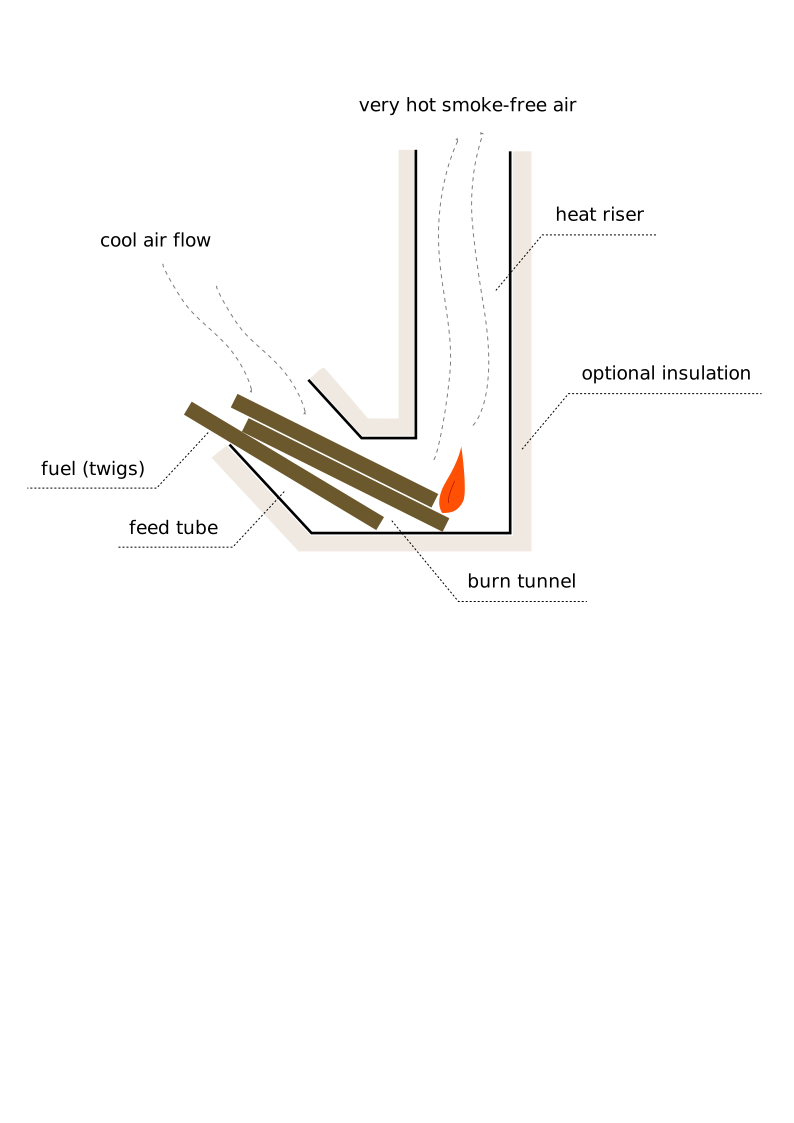
The fundamentals are shown in Fig. \fig5.
Fig. \fig5: Rocket stove fundamentals
Ratio between the three tubes (feed:burn:riser) that should work well should be 1:2:3 but the best way to proceed is to keep the feed tube and burn tunnel as short as practical and the heat riser
as tall as practical.
The structure can be made by welding iron pipes but also more easily, e.g., by combining two cans and
an elbowed flue pipe.
Note that adding fuel is decreasing pipe volume used for oxygen intake so it's probably not good to have too much fuel at any time in the stove - clogging the intake pipe could result in cool
air being pulled down through the riser which would greatly decrease stove efficiency and the stove would not be a rocket stove anymore.
To prevent this from happening, a separate pipe can be added for oxygen intake or the intake pipe can be simply divided into two compartments - a big one for fuel and a smaller one which would
ensure there's always some free capacity for airflow.
Although insulation is optional, it is generally highly recommended for the heat riser to be insulated, otherwise efficiency will be significantly decreased.
Note that insulation here, due to extreme temperatures, implies some exotic material (like fire bricks, perlite or vermiculite) - a material that might not be locally available.
But there are cases where high efficiency is not desirable - e.g., one might want the stove to produce usable amounts of ash and charcoal to
use in the garden.
However, efficiency doesn't have to be sacrificed as much - enclosing the heat riser with another pipe and filling the space in between with wood ash/clay mixture will provide some insulation.
Rocket stoves of lower efficiency can also be built using concrete, bricks and/or a mixture of clay and sand.
The indoor version of a rocket stove will require additional parts - typically, a barrel enclosing the heat riser with a hole near the bottom for the exhaust pipe which will lead smoke out of
the house.
Cleaning
One really should not be obsessed with cleaning, anything - it is simply unhealthy. If one doesn't use artificial chemicals anywhere, most if not all of cleaning can be done using plain
water and natural materials.
I drink my water from the same glass for at least a month, although I do keep the glass with water in a cold place. I generally eat [meatless] soup daily, but the pot and the spoon I use for it
are washed every 7 days or so - I simply cover the pot so flies don't get in there, but I see no reason for these to be washed every day (after all, leftovers are boiled along with the water
for the soup).
It all depends on the type of food, but there is generally no need to wash all the dishes daily and to sterilize them, it is generally better (cost-effective) not to do any cleaning by sterilization.
I have never been sick due to these habits and it is highly unlikely this ever had a bad effect on my health, more likely, it helps to keep me healthy. I am, generally, hardly
ever sick. The biggest problem I had with my body was skin allergy, which I have successfully solved once I have renounced polarized cancerous behaviour.
Cancerous individuals are diseases and attract diseases, perhaps that is why they can be obsessed with cleaning, but if one doesn't want to be cancerous, one will have to stop behaving like it
is eventually. And it is better to stop sooner than later, because it only gets harder.
Added chapter House animals.
House animals
Fear of wild animals is somehow embedded into consciousness of many polarized people. That fear is generally irrational, in most cases presence of wild animals is not a threat (in most cases it is
beneficial) to people and may be dangerous for the wild animal rather than to a domesticated man. Sources of that fear can be various - it may be instinct inherited with inter-species soul
oscillation (e.g., territoriality of domestic canine species), it may be induced by industry, selfishness, etc.
In neutral people, however, this fear should not be present and such people will be more open to sharing habitats with wild animals, rather than with enslaved (domesticated) ones.
Some wild animals, such as shrews, lizards and spiders should be welcome guests in a sustainable house. These will not bother one and will hardly be noticed during daily activity, yet, they will keep
the house free from insects that can bother people (e.g., ants and flies).
Spiders generally weave webs in rarely accessed places, such as room corners. Shrews move along wall edges and prefer darkness. Lizards generally hide from people (at least until they learn one is not
a threat).
I love these animals, in fact, they seem to behave like me - I love visiting places rarely accessed by other people, I don't flow within the mainstream and I often avoid people, especially polarized
ones. Pets of polarized people, on the other hand, I often see as pests, they're generally intrusive, abusive, needy and territorial - not unlike their owners, in a lot of cases. If one takes an animal
from its mother one needs to be its mother - not only provide it food but bring it up and educate it like one does with its own children. Why do people enjoy being lousy parents to animals? That's sick to me.
Materials
Wood, rock and clay may not be the best materials for some constructions. But one should not be deceived with 100% recyclable materials. Aluminium is, for example, almost 100% recyclable, but mining
and extracting aluminium from ore is generally very environmentally expensive. Extraction of bits of material from tons of ore as part of an industrial process cannot ever
be environmentally friendly.
Therefore, if one believes a different material is needed, it is not good to dig deep in search of it. Digging deep holes into tissue, muscle and bone is something
cancer does. Make it simple - materials (minerals, rocks) and fluids deep down surely do have some purpose but it is highly unlikely they are there waiting for those above the surface. If one
really need them, they will appear on surface eventually, either from below or in form of meteorites. That is, unless one is cancerous.
Update in chapter Depth.
Added chapters Depth, Temperature regulation and Air conditioning.
Depth
Regardless of climate, unless there is a cave nearby, if one wants a cheap, sustainable, environmentally friendly house, one will likely have to dig.
I find houses and construction of houses today completely insane - both extremely expensive and energy intensive.
On top of that, these houses are, to me at least, unbelievably ugly.
And why is that? Because someone has to have a job, someone has to produce, someone has to create debt and someone has to slave, while definition of beauty is dictated by those who produce it and
consumed as any other command by those who slave.
I can't believe I used to buy all that crap myself. Now, I know that a good, healthy and sustainable house can be built with no creation of debt, excessive usage of energy and resources.
One just has to ensure proper depth and proper temperature regulation (not total insulation).
Note that, as long as the house is built on a hill, it's generally better to first dig and then build the house. But even if the house is already built above ground one can always add soil around
and on top of it. Such solution might be necessary if the house is in an area prone to flooding.
Of course, a house with multiple floors complicates things and probably should not be an option.
An important benefit of a buried house is increased resistance to radiation and earthquakes (according to my hypotheses, both will be increasing in the future). During an earthquake, seismic forces
act on the whole buried structure equally so it is highly unlikely that the walls will collapse (if the house is not buried forces act directly solely on the foundation, causing instability).
Temperature regulation
Low-density materials (such as polystyrene) are very good insulators, high-density materials (such as iron) are very good conductors of heat. A very good temperature regulator should not belong to
either of these - it should be at least partially liquid and have high heat capacity. A liquid with highest heat capacity is water.
What makes water ideal is not heat capacity alone. Water exists seasonally in three different aggregate states, at the same [atmospheric] pressure. So its heat capacity near surface is not
constant - in solid form (ice) heat capacity of water is halved and it behaves more like an insulator. In gas form its heat capacity is similar to ice but in that form it is a good heat
conductor (through evaporative cooling), not insulator.
Thus, in winter, water in the form of ice or snow on the house will help it conserve heat, while during summer, evaporation of water will transfer heat away from the house.
There's an additional benefit here if the house is underground (or partially underground in a way that the roof is accessible). If one wants to increase temperature during winter, one can simply
shovel some snow on the house. Similarly, if one wants to decrease temperature during summer, one can water the soil on the house and around the house.
Obviously, organic natural materials that are flexible and breathe, are the best possible tissue for house walls, floors and ceilings.
Water is most responsible for regulation of temperature on Earth (there's so much one can learn from god Earth!).
On the poles, water ice is used to keep temperatures low, elsewhere, in the form of vapour (clouds) it acts as a greenhouse gas - keeping temperature suitable for complex life.
On the poles, it is also an insulator for life below, while in tropics it transfers heat away.
Amount of water needed to ensure its temperature is relatively constant over time (equal to average of external oscillation) is proportional to period of oscillation of external temperature.
Note however, that, regardless of amount, water near surface will still oscillate, with oscillation decreasing with depth.
A mixture of soil and plants will also regulate temperature with sufficient depth but generally better if water is present (due to increased heat capacity). Therefore, if the house is underground or
partially underground, it would be good that the soil around it (and on it) retains moisture. On the roof this can be accomplished either with high soil thickness and organic matter, or
by succulents, while on the sides, buried wood and mulch on top will help a lot. However, ideal solution depends on climate.
According to studies done in India, diurnal
temperature variation is practically gone at soil depth of 0.2 - 0.4 m (0.2 m for
colder days). Also, interestingly, temperature at depth is closer to daily minimum than daily maximum (mostly pronounced on hotter days).
At depth of 4 m, there is no annual variation of temperature.
However, invariant temperature is not ideal for surface life, it is better to conserve some oscillation and, therefore, not bury the house so deep.
These depths are the same for dry/wet and sunlit/shaded soil. But there is a large difference in temperature at these depths. It is significantly lower in shaded areas and better regulated in
wet soil.
In warmer climates (minimum temperature during winter above freezing) shaded soil (but not particularly wet if the house is completely underground) should be optimal.
This, for example, produced constant 22 °C at 4 m depth in New Delhi in 1981. That's optimal temperature - no heating or cooling required year round. How can one then
seriously consider that expensive solar panels and wind turbines (that do not save energy, only replace one energy source with the other) are a solution to problems like climate
change and not this (which actually eliminates enormous usage of energy for heating and cooling of houses - cheaply)?
Well, we all know the answer to that by now.
In colder climates, dry sunlit soil should be optimal.
Otherwise (in Croatia, for example), shading and moisture should be variable. This can be accomplished by planting deciduous trees around the house (providing shade during summer, but not during
winter) and mulching during summer (keeping the soil wet) but possibly not in winter (keeping the soil dry) - depending on soil amount/thickness around the house and amount of shade.
Generally, the less thick the layer of soil is, moisture gets more important for regulation (flattening of oscillation).
Air conditioning
Air quality is important for life and if quality of air inside the house is low, this should be compensated by spending more time outside where quality is better.
Ideally, there shouldn't be a lot of windows on the house, although, at least two openings on different places would provide additional means of air conditioning.
However, with natural temperature regulation, temperature will generally be different between interior and exterior. In that case, even a single door or window will, due to convection of
gases, cause air exchange when opened. The greater difference in temperature is, the greater is difference in pressure and the greater wind is produced and less time needed to keep the door or window open.
If the house is not fully underground and exposed walls are not made of concrete, rather of a more porous, natural material, air conditioning by discrete openings becomes less needed.
In fact, in that case, it's probably better not to have windows at all, just a door.
Chapter House model updated.
Added chapter House model.
House model
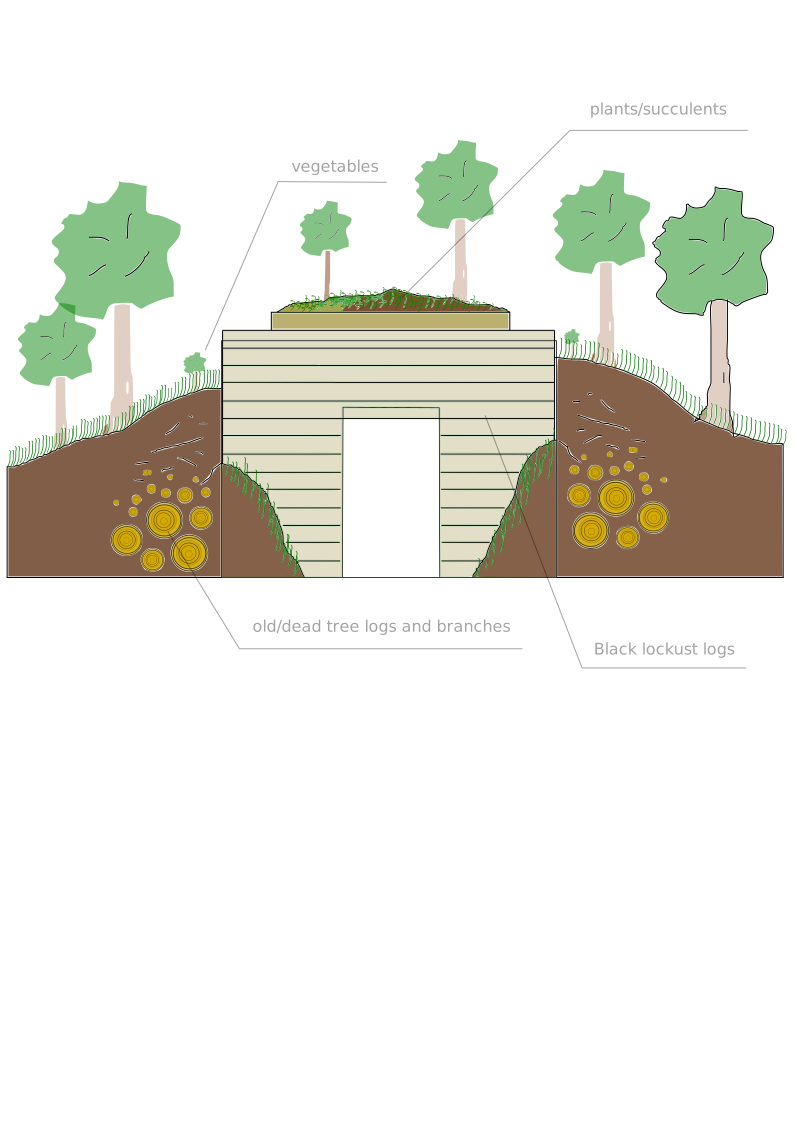
Fig. \fig2: Sustainable house (habitat)
One model of a sustainable house is shown on Fig. \fig2. Here, existing concrete structure originally planned as a basement of a modern house has been used to build a smaller, better house.
Production of concrete is generally not environmentally friendly, it doesn't have all the healthy qualities of natural materials and it certainly does nothing good for wildlife so it probably
should not be considered when building new sustainable houses.
However, if concrete structure already exists, usually, it will be better to reuse/repurpose that structure than to build a new house from start. While its production might be bad for
environment, concrete does have some qualities. Just as porous natural rock does, concrete too will conduct water with exerted hydrostatic pressure, capillary action or transpiration.
If the structure has a hole in the roof (e.g., space left for a staircase) one might opt not to seal that hole absolutely and let moisture inside the house (if hydrostatic pressure does not
provide enough). This would be very convenient for the cultivation of mushrooms (e.g., on a tree log wedged between the floor and the ceiling). That might result in some moss forming in the
house - but what's wrong with moss? It's very usable and I find it much better looking than plain concrete. In fact, it would be good to have moss on the floor too forming a living carpet, it's much
better than a synthetic one - no need for vacuuming, and if one spills water on it - even better. This carpet absorbs water and smaller organic waste. Of course, if the house is not ventilated
regularly, instead of moss there will be mould or at least mildew (which can grow on moss too). For neutral people, however, this shouldn't be a problem either. In fact, in this kind of a
house, this is more likely to be white mould rather than black mould so even polarized people could probably live with it.
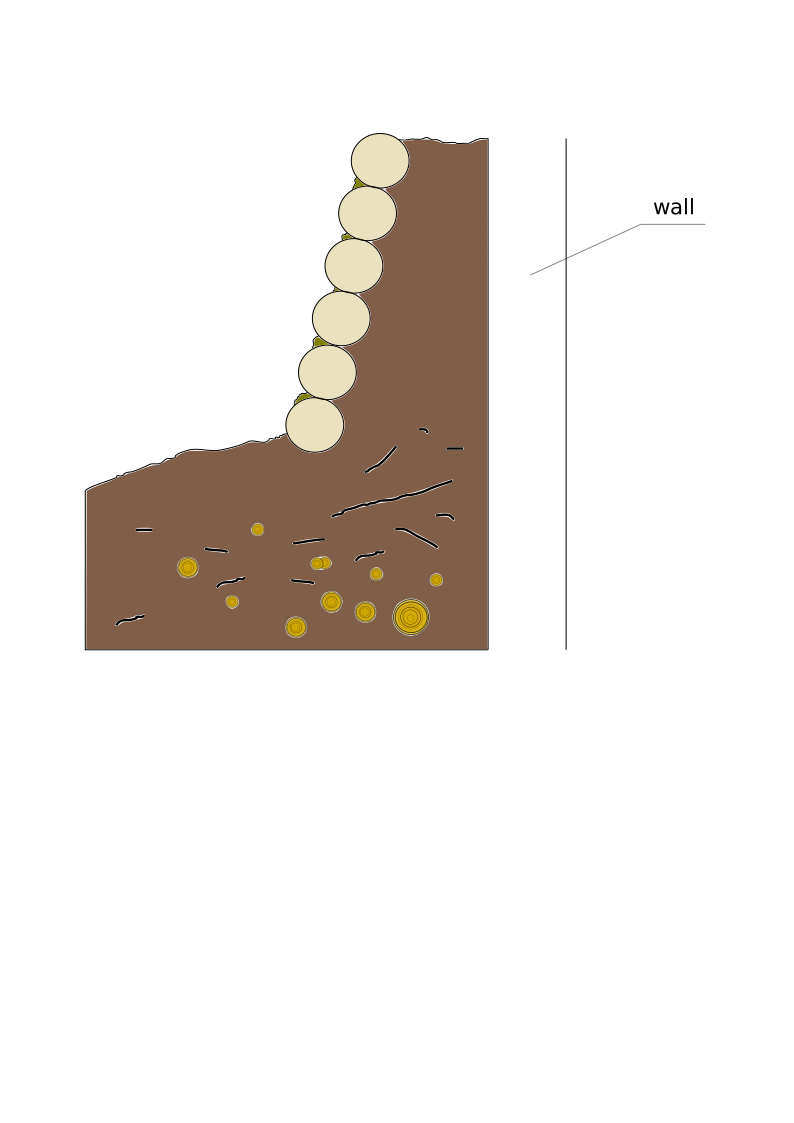
Except from the front, the house is almost completely below ground. Tree logs, branches and other organic material form Hügelkultur like mounds around the house enabling, not only temperature
regulation, but sustainable cultivation of vegetables. The roof is also covered with soil and succulents that regulate temperature below. It is convenient, as shown in Fig. \fig2, to leave some
space on roof edges during construction (especially if one plans to install solar panels later) but this should be later covered with soil too.
Note how the rain in this structure drains from the roof (or solar panels) directly to water vegetables, while the slope ensures proper drainage. Of course, the soil with vegetables should be
mulched.
Note also that, if one wants to grow exclusively succulents on the roof, the layer of soil should not be thick, not more than 10-15 cm. That way, any plants that do not conserve water won't last long
and will quickly form mulch. Mulch will help such plants to survive longer, however, eventually succulents should dominate.
Note also that if the layer of soil on the roof is thicker, the deepest soil might get saturated with water for longer periods of time (forming a water table). Some of this moisture could end up
inside the house. Moisture will also come from the ground and sides of the house if the layer of soil around the house is thick (and high). In modern houses this is prevented with application of
bitumen or tar on the wall exterior and usually combined with some artificial insulation, such as styrofoam. Thus, one might want to apply tar on the concrete where water might
accumulate. Note that tar can be produced through pyrolysis of dried biomass (birch bark will give the highest yield, followed by pine, beech, oak, spruce/fir), which can be performed with
containers in a campfire, or, more efficiently,
in
a microwave oven (usage of common microwave ovens, however, is not recommended as it is not safe - explosions can happen due to gas buildup).
However, moisture in the house is not absolutely bad (it's good for plants, mushrooms, temperature regulation), it can only become undesirable if there's no proper ventilation of air or if
temperature inside is very high. If moisture is high (over 60%) and one wants to avoid growth of mould in the house, the house should be ventilated very often and
walls should be bare (no paint or wallpapers). Moisture absorbers might be necessary where ventilation is poor: silica gel, calcium chloride, clay, activated charcoal, baking soda, etc.
A 1 cm thick clay layer on the floor, for example, could eliminate mould issues. It's a natural moisture regulator - absorbing excess when the air is moist, releasing when the air is dry.
Although aim here is temperature regulation, not insulation, in some cases non-excessive partial insulation might not be bad.
Black locust wood is strong, extremely resistant and durable (it rots very slowly due to antifungal properties). Chemically-treated lumber lasts only a fraction of the lifetime
compared to black locust.
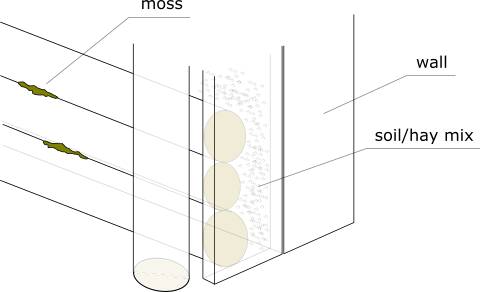
The logs can be processed and stacked on top of each other just like in ordinary log cabins, however, this is not the best solution when stacking logs next to an existing wall.
If there is some air left between the wall and the logs, the logs might absorb energy from the wind and sun radiation, but with no regulating layer in between, the effect of logs on house
temperature would be weak.
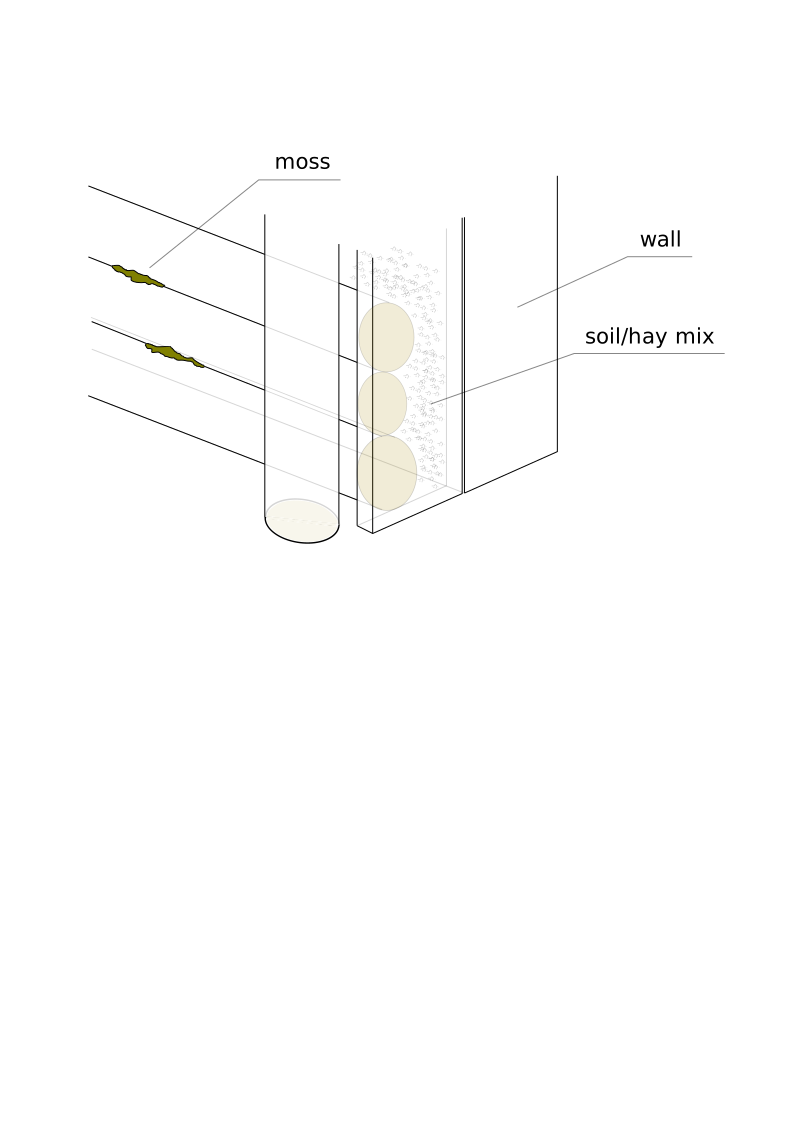
It would thus be good to intentionally leave some space between the logs and the wall and fill that space with sealing material (tissue) - such as a compact mixture of soil and hay.
Plants (e.g., moss) will eventually grow from that soil making the system even better.
Note that, in that case, there's no need to take off the bark and process the logs.
Of course, it might be necessary to take steps to prevent initial erosion of the soil by rainwater. It might be possible to avoid this by allowing some erosion of the soil on the roof.
If the soil on the roof is bounded with planks, there will be some space between the planks and the roof floor. Rainwater will carry micro-particles of soil (and nutrients) through that space to the
edge of the roof and replenish the soil between the logs and the wall.
This should not be a problem for the soil on the roof, the erosion would be small and that soil is replenished with locally produced waste (decomposed organic matter) and dust carried and deposited by wind/rain (dust
can be rich in nutrients, such as phosphorus, and can come from far away -
dust
from Sahara, in example, is known to be fertilizing the soil in Amazon).
Note that this also benefits the vegetables planted around the house. It would thus be good to throw organic materials (such as those for compost) on the roof soil and make it rich in nutrients
which the rainwater will carry to the vegetables.
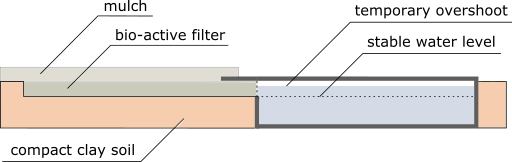
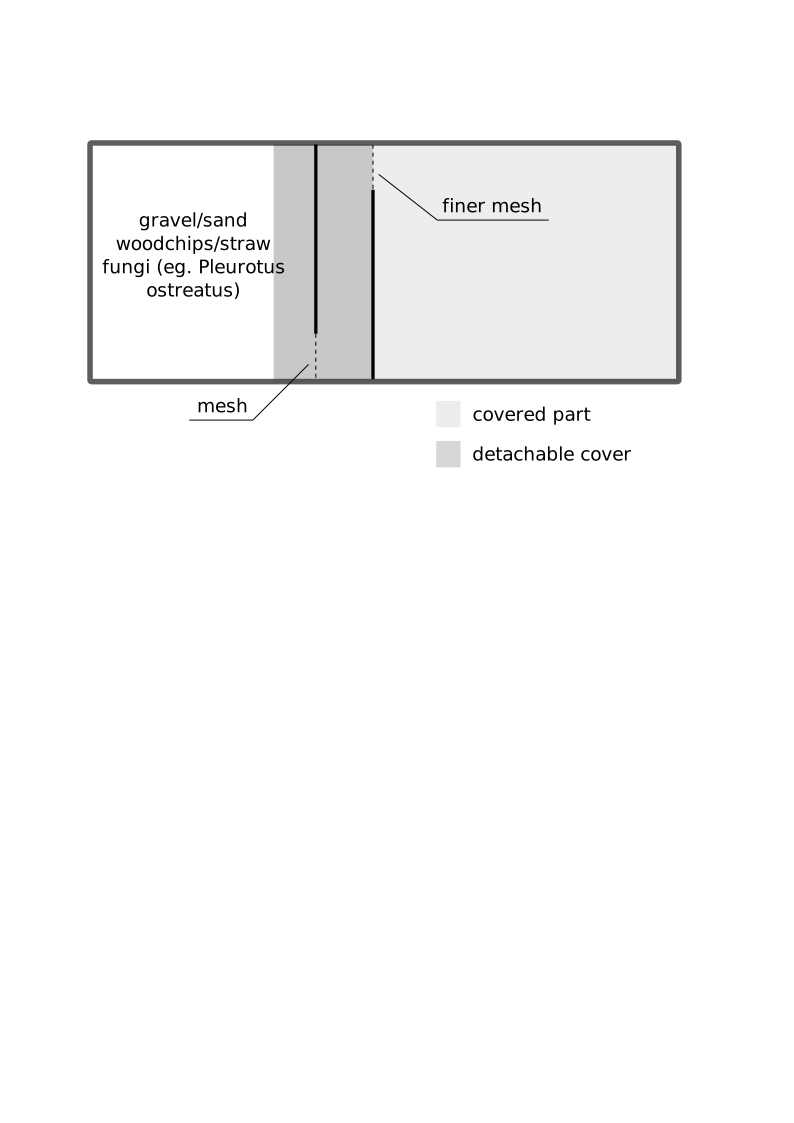
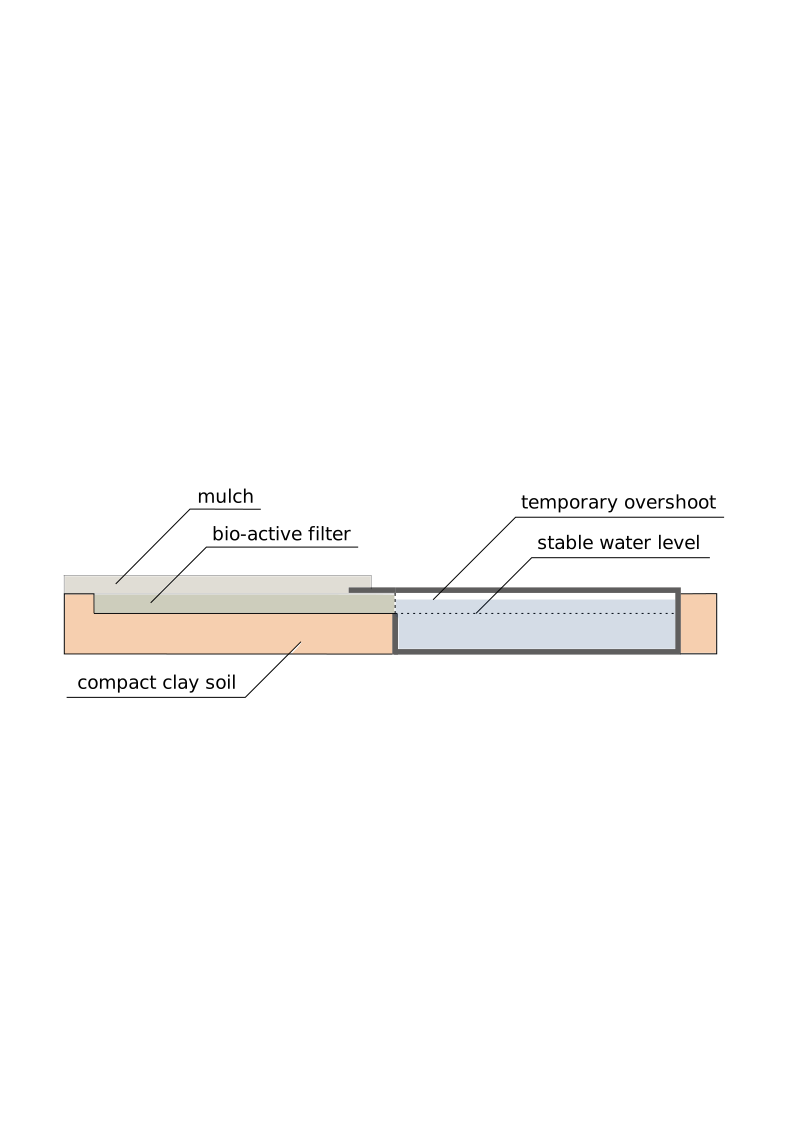
- build the bottom layer by scattering sawdust or wood chips to a depth of 7-10 cm,
- on top of that add sawdust inoculated with mycelium (about 1 kg of sawdust per 1 m2),
- add a layer of corncobs 10 cm deep,
- add another layer of inoculated sawdust,
- cover with waste cardboard,
- add a layer (mulch) of straw (preferably wheat) 10-15 cm deep to ensure shade, aeration, and moisture to layers below.
There are various ways to inoculate sawdust with mycelium. The simplest method perhaps is to chop the fully grown oyster mushrooms into small pieces and mix it all in with the sawdust. As long as
there's some moisture in the sawdust, mycelium should start to grow within a couple of weeks.
Pleurotus ostreatus, or oyster mushroom, is an ideal candidate for bio-filtration. It doesn't just break down many bacterial pathogens (e.g., E. coli, Bacillus sp.), it breaks down
petroleum products, pesticides and chemical weapons as well. It also accumulates mercury.
Note however, that the best time to try this method is during colder temperatures (≤10 °C), to ensure mould fungi (e.g., Trichoderma) don't overpower the Pleurotus, although these
fungi can also filter some pollutants.
Once established, the filter will mature in a few months and remain viable for years, provided that fresh organic debris is periodically added to the top layer and covered with straw. After some
time, however, worms will appear and everything will be transformed into rich soil. At that point, the produced soil should be removed and a new filter should be built.
The produced soil can be used elsewhere. Since it should be rich in nutrients it should be well suited for plant cultivation.
\ch_added
Case study
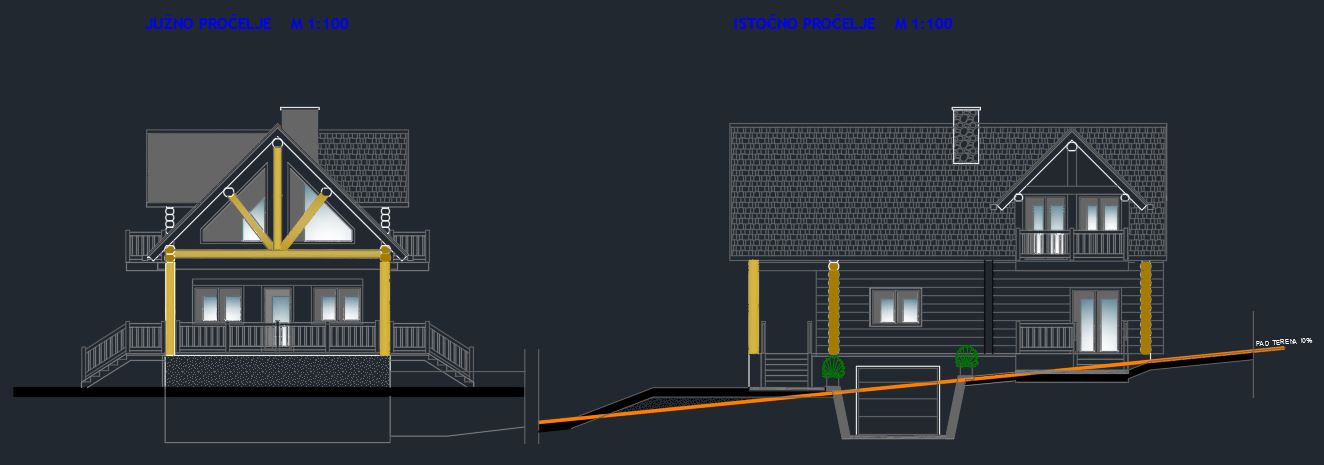
Some ten years ago I started building a house. At that time I was a polarized man, with plenty of money. When finished, the house was supposed to look like shown in Fig. \fig6.
Fig. \fig6: Initial design
While that house would perhaps look nice (the walls were supposed to be made of thick logs) it would be expensive, have a conventional roof (with nothing growing on it) and it would create a
lot of debt to the environment somewhere that would be probably left unpaid.
Luckily, I transformed and got moneyless before it was completed. I don't need a big and expensive house anymore but I do want a relatively passive house to live in. I decided to use what was already
constructed and turn it into such house. So what I had at the beginning was a concrete construction with ground excavated around it (it was supposed to be a basement, completely below ground
on the north side). The structure had two rectangular holes for windows on the south side and a large opening for doors (supposed to be garage doors) on the east. There was also an opening on
the roof where a staircase was supposed to be.
Floors and external walls are made of reinforced concrete while internal walls are made of block bricks (like Nexe MB3 Optimum). Dimensions are shown in Table \tbl1.
| item | dimensions |
|---|
| house area | 7 m x 12.5 m = 87.5 m2 |
| external wall thickness | 26 cm |
| internal wall thickness | 25 cm |
| internal height | 2.41 m |
| roof (ceiling) thickness | 18 cm |
| floor thickness (on foundation) | 22.5 cm |
| entrance door | 3.05 m x 2.21 m |
| windows | 1 m x 0.5 m (2x) |
| internal doors | 0.92 m x 2.10 m (2x) |
Table \tbl1: House dimensions
Building intro
First, I decided to cover the hole on the roof. For that purpose I've used some leftover material from my father's work - one sandwich panel and one sheet of metal supported by a couple of
steel bars laid across the hole. No tools were used, it was all simply laid over the hole. I covered this with a big thick sheet of nylon which in the end covered a good part of the roof, not
just the hole. Next, a bit north from the house I dug a big hole for a lake and used the excavated soil to cover the roof. The thickness of the layer of soil on the roof varies but it is currently
about 16 cm on average (I do plan to add more soil later, about 16 cm more).
The hole cover is not entirely waterproof so after heavy rains the water is leaking into the house. I was thinking about fixing this but once I saw moss growing on the wall below the hole
and even some vegetation on the ground I decided to experiment. The plan is to put some soil in this corner of the house and let plants grow here. It seems like an ideal place to grow starter
plants, mushrooms or any plants one would like to have in a house (the idea of no need for watering of plants seems very attractive to me). I've already wedged a birch log between the
floor and the hole cover above. The log already has some mushrooms on it. I have some leftover bitumen, cement, sand and bricks so I decided to use this to contain the soil and water in this
corner. Of course, a small channel on the bottom will be made to lead excess water outside.
I am aware that this could result in excess moisture and mould in the house - hence I'm calling it the experiment, but I will not give up on this, rather adapt if necessary. I'm not afraid of the
mould - after transformation I am not so sensitive to allergens anymore nor am I worried about mycotoxins.
I am not afraid of the moisture either. A very thin layer of bitumen was already applied to the north wall exterior but it wasn't applied to other walls.
I also considered using styrofoam and polyurethane (my father has a lot of leftover sandwich panels and styrofoam) on some parts of the wall but I decided against it initially. Later, I realized it
might not be bad to use some of it. So I'm leaving it as an option and will decide on it later.
This probably means that some moisture will penetrate inside but it may not be noticeable (the walls are very thick). I am aware that this could produce cracks in the walls, however, I like the
idea of a breathing house so microscopic pores on the wall and cracks don't bother me much - but this could be understood as another experiment.
If one wants to live sustainably one will want to find ways to embrace nature rather than fight it. Plants enjoy moisture and some plants do not need direct sunlight (e.g., moss). Partially moist
walls don't have to lead to diseases (especially if one is used to embracing nature - in that case, increased moisture may be boosting immunity) but can be exploited to grow something and that
something does not have to be mould. In any case, research
shows that mould is not as dangerous as commonly thought, but I do want to avoid the smell and stale atmosphere associated with moulds and high humidity.
So far I have partially buried the house. The south wall is covered with soil about 0.83 m in height on average (1.2 m max.) and over 1 m in thickness, a good part of the west wall is covered
with a mound of soil 1.54 m high, 1.7 m thick at the bottom and 0.85 m thick at the top. The north wall is covered almost to the top in the middle. Many months and many heavy rains have passed
since I've started burying the house and no cracks have been created nor have I seen any moisture on these walls inside.
Therefore, I don't think I will have any problems with this once the burying is complete, besides, the house isn't meant to last forever and I don't think it will collapse any time soon.
I have to mention though that a perforated drainage pipe was laid around the house before so that could be helping too.
The plan is for the mound of soil next to all walls to reach about 1.54 metres in height with about 0.85 metres in thickness on top. Above that height the plan is to stack logs of black
locust, starting at some distance from the wall but with gradually decreasing distance with height. The space between the logs and the wall will be filled with soil (as in
the "Alternative design" of the model above). The plan is then for the soil on the roof to meet the soil around the walls so no concrete will be left exposed. However, I can foresee some difficulty
in achieving this on some sides of the house so I might give up on complete coverage. In example, there are a couple of young oaks growing very close to the house and I don't feel like burying
them with metres of soil (I wished for trees to grow around the house - to provide shade in summer but also mulching of the roof soil in autumn, so I actually consider these trees as part of the
house). Also, coverage of the area next to and above the entrance could prove challenging and may not be worth the effort.
Whether one enjoys it or not, it's not easy to manually surround the house with soil so burying something together with the soil could make it somewhat easier. I had some plastics I wanted to
get rid of so I figured it would be best to bury it here. Also, while I'm occasionally clearing some bushes (to make room for the forest) I occasionally have a lot of cut thorny bush nearby
so I'm throwing that too in the mix. Ashes, dead wood, sawdust have been occasionally added too. Apart from plastics (which I have concentrated in one place), all this extra material is a welcome
addition to the soil so the heaps around the house in the end will form Hügelkultur like mounds, good for plantation of vegetables.
The configuration of the terrain here is such that, once I'm done adding soil a channel will exist around the house (except for the south side). This should also help in driving excess
water from the house.
Note that the house is on a hill and the hole (for the lake) I dug out on the north is also collecting water. The lake is connected with a channel
to another experiment which is connected to drainage channel at some
height. All this is further preventing accumulation of water near the house and channelling excess water around it.
It seems I've done quite a lot to prevent flooding of the house but that was not a primary purpose in any case - I didn't even do it consciously (I'm generally guided to construct things that end up
having many useful interpretations). However, I have announced elsewhere significant flooding for near future so this could prove very useful (it's also not a coincidence I like living on
mountains). Even without my predictions, global warming, among other things, means more heavy rains.
It also might seem that I've done quite a lot to protect the house from radiation, however, that is yet another benefit not consciously considered even though I have predicted the collapse
of Earth's magnetic field in near future too (and nuclear wars certainly cannot be excluded either). I do not see myself as a prepper, certainly not a conventional one.
I do not plan to stack canned food (even if I'd have the money) and water and to keep myself inside the buried house for years or even months, for a couple of reasons:
- danger of nuclear fallout generally drops off exponentially with distance from detonation and I don't see such detonations happening nearby in near future,
- studies show that somewhat elevated levels of radiation are beneficial rather than harmful,
- collapse of the magnetic field won't be instantly global, I believe it will fragment and some fragments will be longer lived (obviously, due to my
symbiosis with god, I believe one such fragment will be protecting my house),
- I prefer dying and reincarnating in an environment suitable for life rather than living in basement on canned food (this, simply, ain't living for me at all, it's waiting for death).
However, I am effectively preparing for future, just not for a short-term one as a polarized short-term man.
Protection from earthquakes can also be added to the list - again, I did not plan it but I did announce strong earthquakes in near future.
I have arranged with my father for him to construct the frame for the entrance doors from leftover profiles. The plan is also to use leftover sandwich panels for the doors.
I believe there's leftover material for windows too. As for the black locust logs, there is a small forest just south of the house. I have planted some additional trees there to increase the
diversity but also because I will be taking out some trees occasionally. All in all, materials used here couldn't be more local, nothing has been bought, there's no heavy machinery involved in
building and transport, and there's no long-term damage to environment.
Once this is done, measurements of temperature and moisture will be performed and results will be posted here.
Wind rose
One thing usually not taken into account in house design and building is wind speed and direction, however, if the house is in a relatively isolated space (e.g., on a hill, not surrounded by other
objects) it would be good to take it into account to further optimize energy usage. For a house completely below ground level this obviously ain't relevant but for anything else it's worth considering.
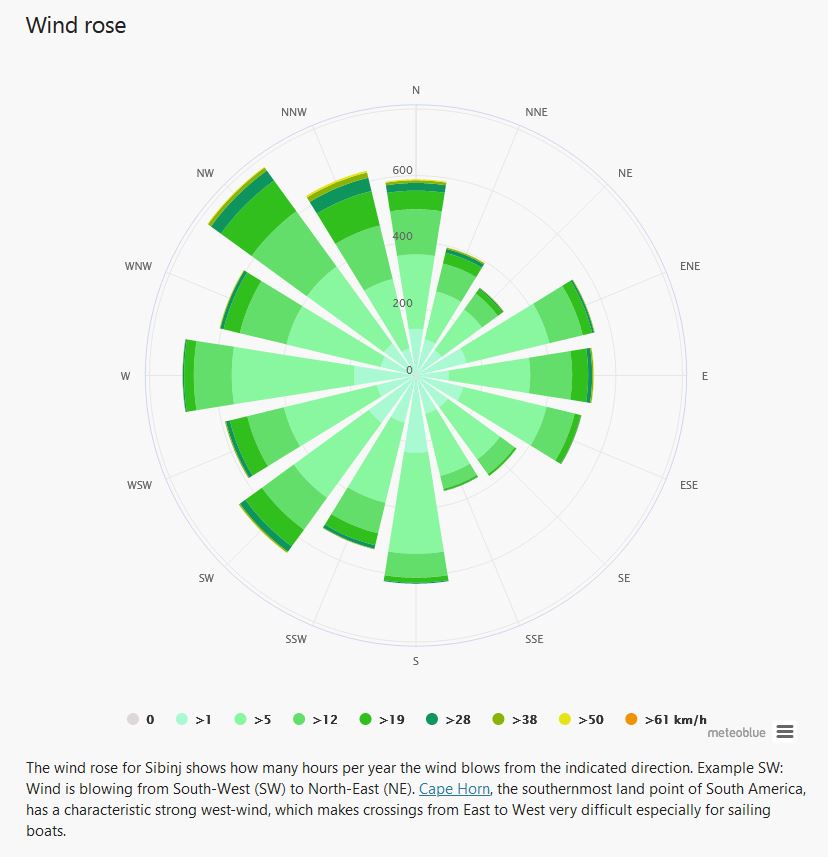
Usable graph for that purpose is a wind rose, as shown in Fig. \fig7 for my location.
Fig. \fig7: Wind rose for Sibinj
In this case, winds evidently generally blow from the west and the strongest winds mostly blow from north/north-west. Based on this graph, one should avoid putting windows on the north and west
side, optimal location for windows is south (taking also sunlight into account). Optimal location for a room where one would spend most of the time is also south. Optimal location for entrance
doors, which are huge in my case, is south-east.
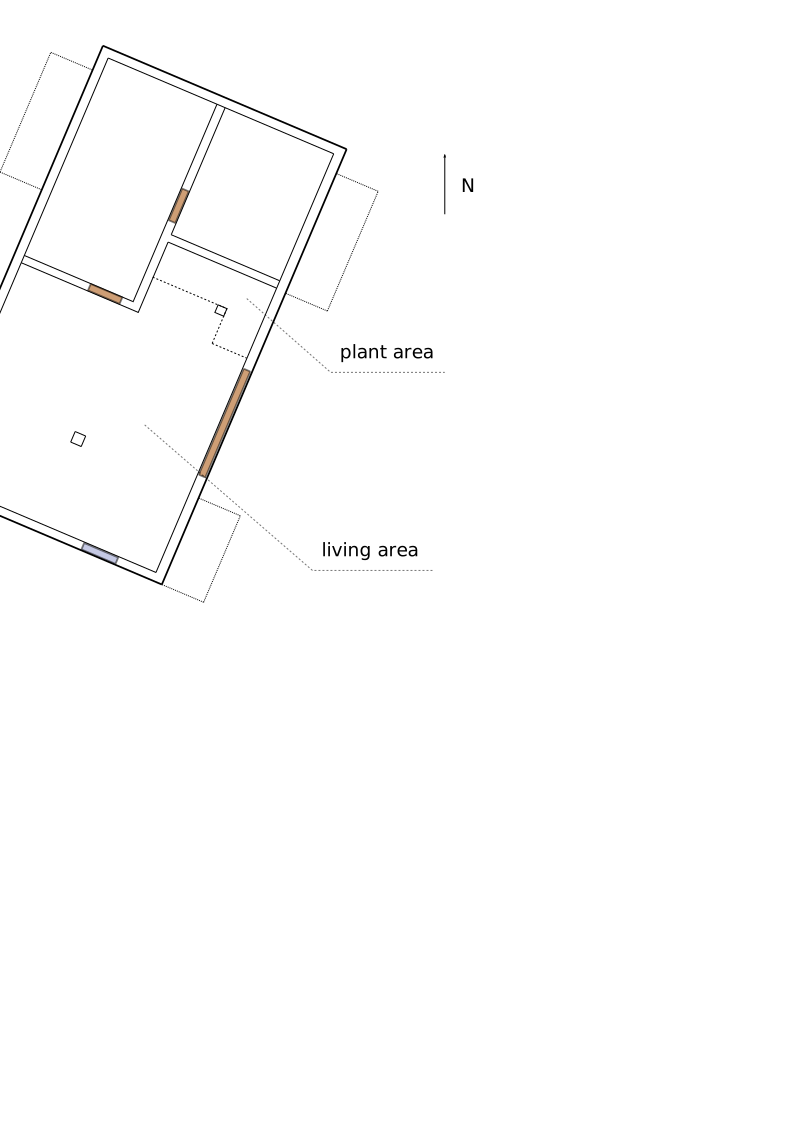
Interestingly, even though I wasn't consciously taking wind into account when I was designing and building the house, it seems I was, again, guided toward the optimal design and orientation, as
shown in Fig. \fig8.
Again, a good example of relativity in causality (which commonly gets inverted for me). Here, I've designed and oriented the house in optimal way before I came up with the optimal way to do it.
Fig. \fig8: My house plan and orientation
Entrance doors
In conventional houses large entrance doors are undesirable. Here, however, large (but well insulated) entrance door could make sense. Not only does it make the living area easier to
ventilate but it could help drive in hot air during summer in case it gets too cold inside. An added bonus is that one can move things more easily in and out of the house.
In my case the entrance is as big as a typical garage entrance and since it is partially below ground an ≈10 metre long pathway has been dug leading to the entrance. Since the soil around the
house is excavated (and will probably remain so to some degree at this side of the house even once I'm done burying it) the walls of the pathway are not really connected to the house, however, with
fully opened doors this is no longer the case and the pathway can efficiently channel the southern/eastern breezes through the house.
\ch_added
Building log
About a year ago (around February, 2022) I have added a layer of soil to the roof, about 16 cm high on average. Wooden planks were put around the edges of the roof to contain the soil (prevent high
erosion), some extra space was left on the south side of the roof (about 1 metre wide). Planks will be removed later - once the work is done and significant vegetation is established. The extra space
left on the south side will also be covered with soil later but for now it comes in handy.
Later the same year I have started adding soil around the house. The soil is coming either from experiments I do north of the construction or from nearby mounds that were created about 10 years ago
when the soil was excavated in order to build, what was supposed to be, the basement. I work on this 2-3 hours per day, sometimes less, I don't work at times of heavy rains and I did not work on it
over winter. Also, sometimes I skip it if I'm too busy with other stuff or if food is scarce. Thus, this will take some time.
2023.02.16
Heavy rains of winter (!) seem to have stopped and the temperatures have risen so I have resumed adding soil to the house.
2023.02.18
Entrance doors have been installed. They are big but they are well insulated - the built-in panels contain a 5 cm thick layer of rigid polyurethane (one of the best insulating materials commercially
available), roughly equivalent to 10 cm thick rock wool or 38 cm of typical soil.
| material | thickness [cm] |
|---|
| extruded expanded polystyrene (XPS) | 6 - 9 |
| moulded expanded polystyrene (EPS) | 7 - 10 |
| polystyrene board | 7 |
| fiberglass batts | 8 - 10 |
| cardboard | 8 - 12 |
| rock/slag wool batts | 9 - 12 |
| straw bale | 10 - 14 |
| wood | 30 - 42 |
| snow | 32 |
| soil (20% moisture) | 32 - 150 |
| brick | 150 |
| poured concrete | 260 - 530 |
Table \tbl2: Thermal insulation equivalents of 5 cm rigid polyurethane (with R-value of 46 m2K/W per 1 m)
Equivalents of 5 cm rigid polyurethane insulation for some typical materials are shown in Table \tbl2.
Evidently, soil is not the best insulating material so one would need much of it for the same effect, however, it is free, environmentally friendly and, unlike best insulators, has high heat
capacity which is essential for temperature regulation (something I aim to exploit here). Another benefit of the soil, as noted before, is its flexibility - its heat capacity/insulation can change a
lot with change in water content and temperature. In addition, soil is alive (contains microbes and other animals) and can grow with time. Vegetative cycles and amount of vegetation also
influence its thermal properties.
Note that as the soil rich in vegetation warms the activity of microbes and animals in it increases as well but this activity will further increase the temperature so the soil is not only a
heat capacitor but a source of heat.
Considering sustainability of houses a flexible material that has multiple purposes is generally a better choice and one should not limit itself by considering only thermal properties and
energy efficiency. Soil can grow food and the ability to grow food locally certainly correlates with sustainability of life.
\ch_added
2023.02.21
I was thinking about how to further increase efficiency of energy usage in the house. Interior walls have low thermal resistance (bad insulation) - which is commonly the case in houses and this is
not good if one does not want to heat all the rooms in the house. It is good to have rooms with different conditions - e.g., living room(s) with higher average temperature and storage room(s) with
lower temperature. Therefore, I have decided not to insulate the house equally from all sides. I have decided to use the available leftover insulating material (e.g., styrofoam) on some internal
walls and not to insulate (using soil) external north-east walls (part of the north-east room) so the living room on the south will have a higher temperature compared to other two rooms.
The north-east room will be a cold winter room (cold in winter, relatively warm in summer) while the north-west room will be a cold summer room (cold in summer, relatively warm in winter).
In other words, the north-east room should have a temperature relatively close to outdoor temperature while the north-west room should be like a typical basement room.
Thus, at least one of these rooms could be used as a fridge or storage room at any time during the year.
\ch_added
2023.02.25
Apart from the topmost layer where vegetation is holding them in place, particles of soil are generally loosely held together. That kind of soil is prone to erosion and it will be difficult to
make large stable vertical walls of it. This is generally not an issue when adding soil next to a wall with no openings (windows or doors) but next to an opening in the wall one will probably
want a very vertical column of soil.
To fix the issue one must add stable vertical walls that will contain the loose soil next to windows and doors (and possibly even horizontal above them). Various solutions exist but the
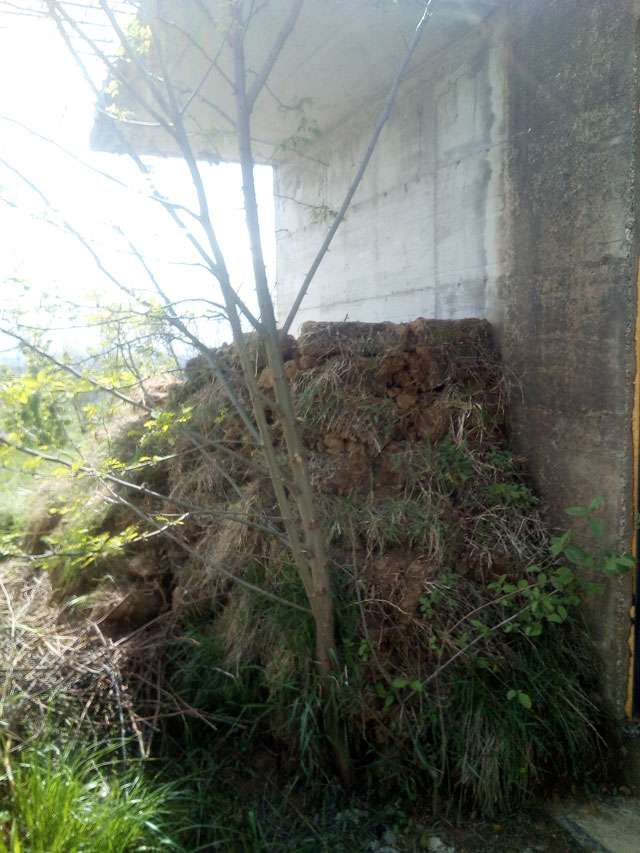
simplest one (requiring no additional tools, material or expertise) is to use heavy blocks of topsoil with grass on them. This is what I chose to do and it's working really well. I simply dig out
a block of soil as large as possible and than stack the blocks of soil as I would stack bricks.
Note however that, depending on conditions (mostly on the steepness of the wall of blocks), this alone is unlikely to be enough to prevent water erosion and will require additional
support, especially initially, until vegetation grows on the contained soil. In my case, I got some help from god Earth here. A black locust tree is growing next to the wall supporting the
blocks, as shown in Fig \fig10.
Fig. \fig10: Black locust holding sod blocks in place
In fact, I was blessed with a tree growing near every corner of the house (although one of them is still too young to support the wall at this time), not only near the entrance.
It's a bit more complicated for the soil above the opening but less complicated if the opening is right at the top of the wall (e.g., like windows on basements). In my case, windows are right below the
roof floor and they are not large so it shouldn't be a problem. Combinations of logs and planks could be the solution but since this is really not a big area and wouldn't affect overall
house insulation much it could be just left as it is.
\ch_added
2023.03.02
One of the common problems with buried houses is illumination. If one is concerned with sustainability one will want to exploit as much natural light as possible so it's worth considering the options
for bringing sunlight into the house. This can be achieved using mirrors but these may not be readily available in required sizes and quantities. I certainly don't have mirrors to use for this purpose
but I do have enough of potential good substitutes. These are used compact discs (CD's), DVD'S and Blu-ray discs. Out of these, in terms of total energy reflected, CD's are the best choice because
they reflect infra-red radiation in addition to the visible spectrum. They are also least complicated - DVD's and Blu-ray discs may contain additional layers of material between the metallic
disc (typically aluminium coating, but silver and gold are also used) and outer layers of plastic (polycarbonate), which can additionally affect reflectivity (one can remove these layers but
this is not recommended as it would leave the reflective disc unprotected from the elements). However, some CD's too can have lower reflexivity than others. Dispersion of light is
also lowest in CD's but that's not so important here.
Generally, great reflectivity of the solar spectrum may be achieved with silver, gold, copper or aluminium [coatings]. Out of these silver is the best.
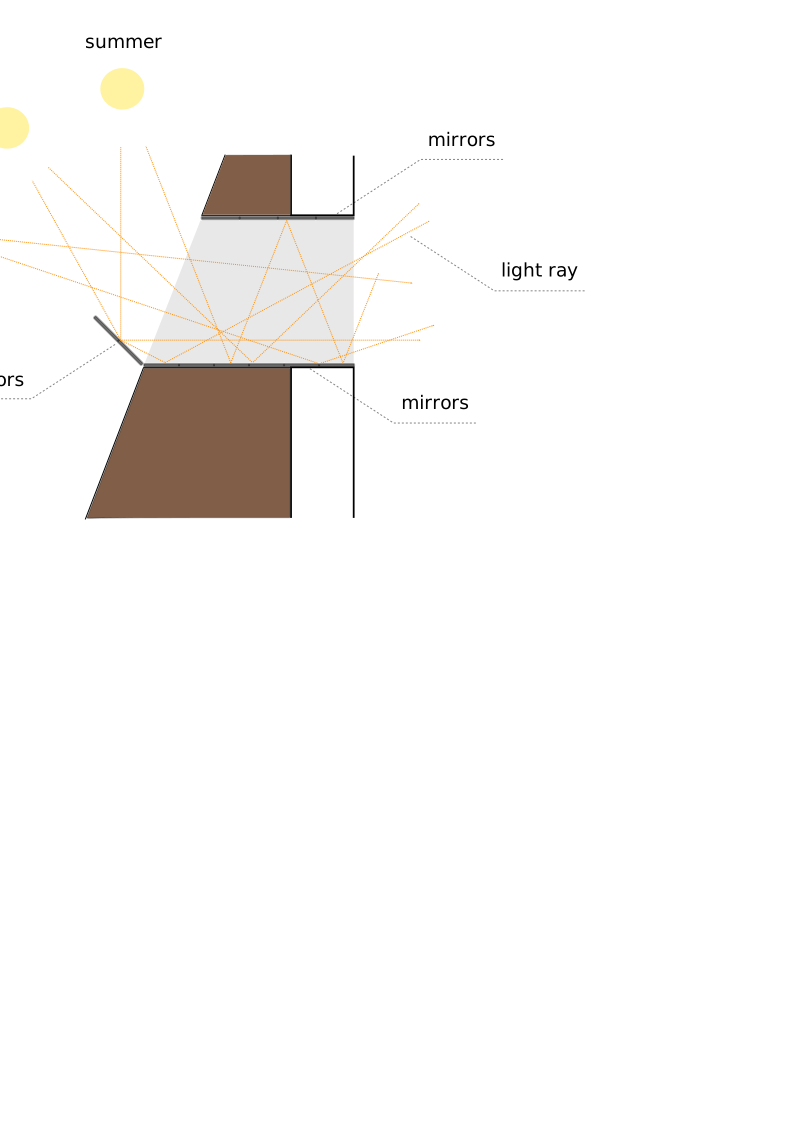
To account for the seasonal movement of Sun, mirrors should be placed according to Fig. \fig9.
Fig. \fig9: Guidance of light
Of course, regarding seasonal movement, mirrors inclined by 45° are optional if the Sun is never directly above the location and don't make sense at all for latitudes beyond ≈63° from the
equator. However, they will still be useful if the window is at an angle relative to diurnal (east-west) movement of the Sun, as in my case (see Fig. \fig8).
Similarly, to account for diurnal movement, mirrors should also be placed sideways.
\ch_added
2023.04.18
I have just noticed there is a crack in the ceiling in one room of the house and the water is slowly dripping through it (the weather has been rainy for the past few days). This was unexpected but
it seems the crack occurred along the installation of a large PVC pipe (note that what I call ceiling now was supposed to be the main floor in the original house plan). There are several pipes
sticking up from the concrete roof (although there's soil around them) so the rain can even fall directly into the pipes. These are all connected to the main (110 mm diameter I believe) pipe
which leads horizontally in south-west direction away from the house. The crack in the concrete follows this pipe. I didn't think of it before but, considering that the concrete ceiling
is 18 cm thick, the layer of concrete below the pipe could be only a couple of centimetres thick so, even though the concrete is reinforced, this is an obvious weak spot.
Interestingly, I've noticed this crack and the leak just two days after an earthquake. I was lying in bed during the earthquake and at the time, for some reason, I imagined a north-west ground
rupture (crack). I remember asking myself why I am visualizing this rupture? What is the meaning in that? Well, it seems I've found it.
I'm not sure if and how I'm going to deal with this. In conventional building, probably the best solution would be to fill the pipe with concrete and perhaps put some tar on top
but, of course, I don't think I'm going to be doing this. It seems to me I should just accept the occasionally elevated levels of moisture in the house. In fact, here's an interesting
idea - why not adding more soil instead of more concrete so the water gets filtered and I get drinking water in the house easily?
How about installing a tank with a pipe below - perhaps even mounting the tank to the ceiling? I will definitely consider this. There's some white efflorescence (deposits of salt crystals) too
where the water drips. Interestingly, few days ago I ran out of kitchen salt and I was thinking how I could produce my own... well, god [Earth] just showed it to me (although this particular one
doesn't taste much salty).
And yes, I was also thinking recently about how I'm going to get drinking water locally if no spring emerges nearby before I move in...
The PVC pipes have been exposed to elements for about 10 years now. I have noticed that their quality has degraded (at least the parts sticking out of concrete). Not sure if this is due to
exposure to Sun or acid rain. Probably both. I did notice recently that metals (e.g., iron) seem to be corroding faster. Note that both moisture and acidity of that moisture are increasing with
global warming. On top of that, all rain falling today on Earth is unsafe to drink due to presence of per- and poly-fluoroalkyl substances (PFAS) or forever chemicals. All this translates to
increased corrosion and salt deposition but also highlights the necessity of water filtration prior to consumption.
\ch_added
2023.05.07
I'm noticing some changes since the entrance doors have been installed. Up until that point, moss was the only thing growing on the walls where water occasionally flows down from the roof.
Now, there's mildew too. Note that windows have not been installed yet but obviously the ventilation is much weaker now (it doesn't help that both windows are on the same wall).
I do keep a smaller one (but still big) of the entrance doors open often (sometimes for days) but I don't think that's enough to avoid mildew. It seems to me that, unless I effectively get
rid of doors there will be mildew. So this is something I will have to live with. If one wants to though, it's very easy to remove this white fluffy stuff - it's more like dust or spores than
developed fungi and it seems harmless.
In other news, I have installed polyurethane panel leftovers (10 cm thick) on the external wall of the plant area (next to entrance, see Fig. \fig8) as I do not plan to put soil on the outside of
this wall and I do plan to keep this room well insulated. I have also started experimenting with clay (soil) plaster (mixture of clay, sand and straw). I'm applying it to the walls of the
plant area.
Added chapters Materials and A living house.
A living house
No matter what kind of house one lives in, if one lives in symbiosis with the environment and its god [on whose surface one lives], one's house will only be a precursor to a living organic house
which may be, eventually, provided naturally (through evolution). This might occur once one evolves into real
homo.sapiens, however, it is possible that such houses (or precursors of these houses) will be provided to some even before.
There is no better, more sustainable and renewable house than a living house.
If one is Earth's precursor neuron protein, this house might have a pyramidal shape and it will likely be larger than one's previous dead houses. It will be connected by veins to root
systems in the ground through which one will be provided cold and hot water. It will probably also have its own energy source and may eventually grow electrically conductive veins to
connect with other houses.
In any case, this will be a relatively closed ecosystem where all one's needs for food, water and sharing of information will be satisfied.
Obviously, such houses most likely evolve from fusion of plant species and will likely be only partially underground.
If these houses do appear on the surface of god in limited number, most likely, polarized homo.beta will try to imitate the design, as it will be an optimal solution given the environmental
conditions.
I'm not sure what is the role of homo.beta here, is it only producing precursors to living houses, or will it be involved in building actual living houses? Humans are already starting
to use mycelium to build house components (e.g., bricks) and it seems houses
made out of living fungi could be a reality soon as well.
Conclusion
The key to sustainable living is proper appreciation of space and time. One should not abuse either, otherwise one will be accumulating stress and one will, not only have diseases, but become a
disease itself.
Space and time are generally entangled - if one doesn't have a lot of space one doesn't need a lot of time to care for it and one shouldn't feel the need for big and expensive machines
to care for it and to care for (when ones does things in a hurry - ones does not care for things, one does maintenance and pretend to care, even when one convinces its self it is
not so).
No house is really small. If one finds a house too small - one probably spends too much time inside it, or has swollen eyes, infected with capitalism. It is vital to spend time in nature
outside. I recommend doing it now and often, while the air is still breathable.
It is easy to live in a sustainable way, but it requires a redefinition of success and a desire for a healthy life, lacking constant abuse of space and time.
Article updated.
Article revised.
Article revised.
Added chapter Construction. Chapter Energy updated.